

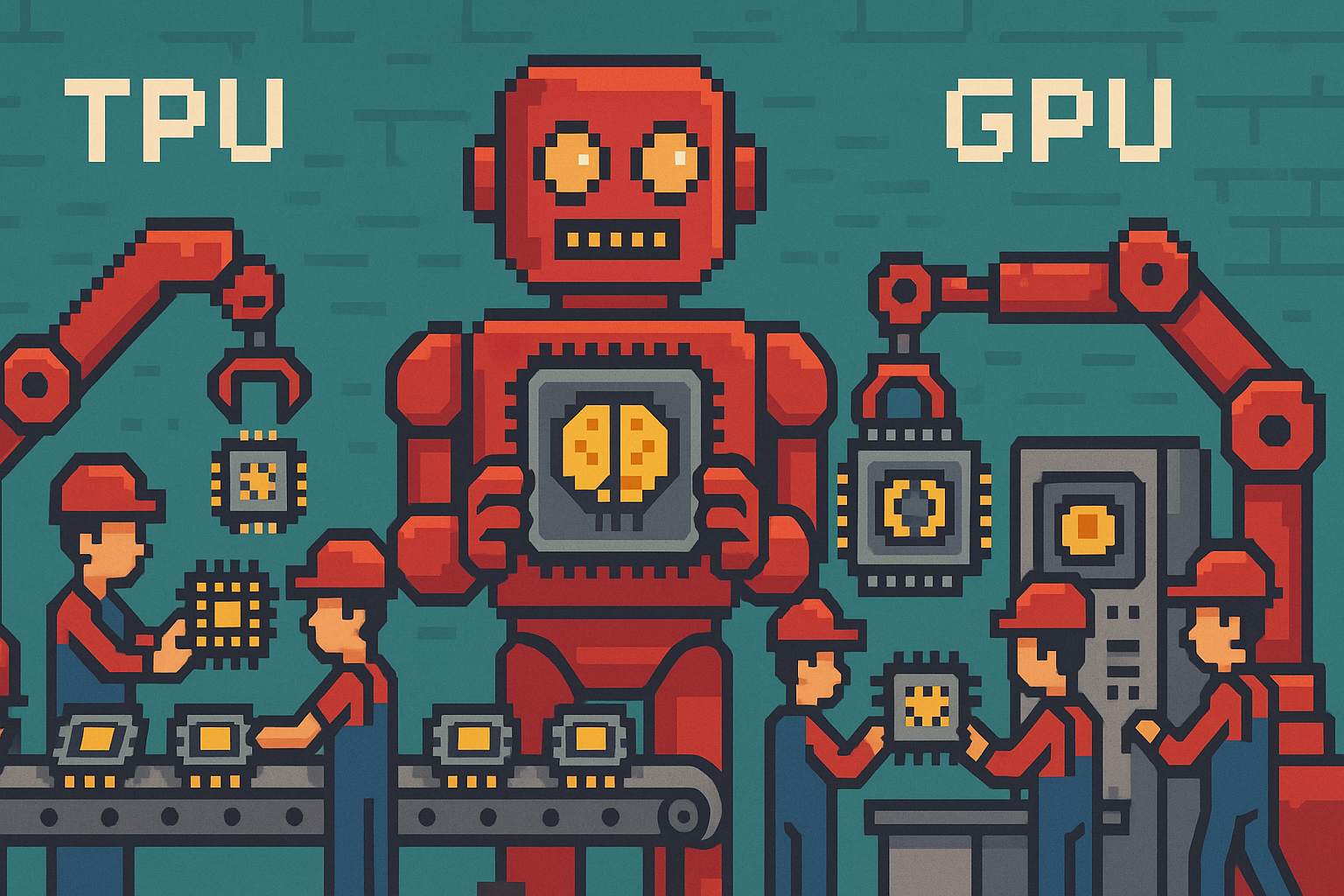

The hot take online is still:
NVIDIA GPUs vs Google TPUs – who wins?
The more useful framing is:
Which technology dominates which part of the AI value chain, and which stock is mispriced for that reality?
Right now:
- NVIDIA is the frontier-training and rack-scale reasoning champion with Blackwell GB300 / NVL72. Demand is still running ahead of supply.
- Google is turning TPU v7 “Ironwood” into an inference super-fabric, explicitly designed to crush cost-per-token and power economics at scale — and it’s signing massive, long-dated commitments on the back of that.
You don’t get a single winner. You get a bifurcated AI stack where GPUs and TPUs dominate different profit pools. The trade is not “who survives”, it’s who’s underpriced given their lane.
What the Silicon Is Actually Good At
NVIDIA GB300 / NVL72 – The Frontier Hammer
Architecture in plain English:
- 72 Blackwell Ultra GPUs plus Grace CPUs in a liquid-cooled rack.
- Exposed as a single giant GPU via NVLink, with exaFLOPS-scale FP4/FP8 throughput and very high fabric bandwidth.
In practice:
- It leads in frontier LLM training – multiple benchmarks show big speedups over the prior Hopper generation.
- It leads in rack-scale inference and agentic workloads, with much higher throughput than previous GB200 rack systems.
- It dramatically improves tokens per megawatt, which matters when racks are pulling 100+ kW.
If you’re training large foundation models, running MoE at scale, or tied deeply into CUDA pipelines, this is the best machine you can buy today.
Google TPU v7 “Ironwood” – The Inference Super-Fabric
Ironwood takes a very different approach:
- High-throughput TPU chips with large HBM3e per device and huge on-chip bandwidth.
- A fabric that scales to thousands of TPUs per pod, with optical switching and liquid cooling designed in.
- Deep integration into Google’s AI Hypercomputer stack: JAX, TensorFlow, PyTorch/XLA, vLLM, managed serving, and GKE.
Economic reality:
- Ironwood offers roughly 10× peak performance over older TPU generations and large per-chip uplifts vs Trillium.
- On the right workloads — large-scale LLM serving, MoE, long-context inference — it can deliver meaningfully lower cost per token and better energy efficiency than comparable GPU estates.
- Hyperscale AI customers are signing up for huge TPU allocations, explicitly for price-performance and efficiency reasons.
In other words: it’s not trying to beat GB300 at everything. It’s built to dominate the economics of serving models at scale.
So, Which Is “Better for AI”?
Depends which slice of “AI” you’re talking about.
| Dimension | NVIDIA GB300 / NVL72 | Google TPU v7 “Ironwood” | Edge |
|---|---|---|---|
| Frontier training (new frontier models) | Clear performance + ecosystem lead | Capable, but not optimized on economics | NVDA |
| Rack-scale reasoning / agents | Unified giant-GPU abstraction | Strong, but less tuned for test-time scaling | NVDA |
| High-volume inference economics | Good, but expensive | Often 50–65% cheaper per token | GOOGL |
| Software & ecosystem | CUDA / TensorRT / PyTorch native | JAX / XLA / PyTorch-XLA, maturing fast | NVDA (today) |
| Price-performance for MoE / LLM serving | Strong, but pricey capacity | Purpose-built for pod-scale, high-utilization | GOOGL |
| Supply visibility (2025–2026) | ~$500B Blackwell/Rubin pipeline | $155B GCP backlog; massive capex ramp | Tie, different angles |
Frontier training and CUDA-heavy workloads: NVIDIA
- Best-in-class for training large models.
- Mature CUDA/TensorRT/PyTorch ecosystem.
- Unified rack-scale systems optimized for throughput and latency.
Conclusion: NVIDIA is the clear choice for frontier model training and complex CUDA pipelines.
High-volume LLM inference and serving economics: Google TPUs
- Ironwood is explicitly tuned for serving: big memory, large fabrics, optimized serving stack.
- Inference-heavy estates can see materially lower $/token and lower power per token versus GPU-only setups.
- For customers already on Google Cloud, the integration story is strong.
Conclusion: TPUs increasingly win on cost-efficient inference at scale.
In the real world: Hybrid is the default
What actually emerges is a mixed estate:
- NVIDIA GPUs for frontier training, CUDA-native research stacks, and some high-end reasoning workloads.
- Google TPUs where inference economics, power budgets, and cloud integration matter more than raw FLOPs.
Even Google Cloud offers both GB300 racks and TPUs side-by-side. That’s the tell: it’s not binary. It’s workload routing, not religion.
Ecosystem Gravity: CUDA vs XLA/JAX
NVIDIA – CUDA as the Gravity Well
- CUDA remains the de facto standard for accelerated AI.
- Tooling, libraries, and developer muscle memory are overwhelmingly CUDA-first.
- Even older GPUs remain economically relevant because the software stack keeps getting better.
That is a huge moat. If your training and experimentation stack is deeply CUDA-native, porting to anything else is a serious engineering project.
Google – Vertical Full-Stack Cloud
Google’s answer is vertical control:
- In-house silicon (TPUs)
- Compiler/runtime (XLA)
- Framework integrations (JAX, TensorFlow, PyTorch/XLA)
- Serving platforms (AI Hypercomputer, GKE, vLLM)
- Datacenter fabric, power and cooling, all tuned around this stack
There is migration friction from CUDA to XLA/JAX/PyTorch-XLA. But for inference-heavy, cost-sensitive estates, the economics are strong enough that enterprises are increasingly willing to do the work — especially when they’re already using Google Cloud for other workloads.
The likely end state: CUDA retains dominance on training, TPUs own a growing share of serving.
Demand, Supply, and Where the Money’s Flowing
Alphabet / Google
On the Google side:
- Google Cloud is growing fast with healthy operating margins.
- Cloud backlog has surged into the hundreds of billions, with AI infrastructure deals a major contributor.
- Capex has been raised aggressively for 2025 with a guidance step-up in 2026, almost entirely in support of AI compute, networking, and power.
- Management is explicit: capacity is tight well into 2026.
TPUs are not a side project. They’re becoming a commercial, externally consumed product line embedded inside that backlog.
NVIDIA
On the NVIDIA side:
- Data center revenues are at record levels and still growing.
- Cloud GPUs remain effectively sold out.
- There is multi-year order visibility across sovereign AI, hyperscalers, and major enterprise deployments.
- Margins remain extremely strong even as NVIDIA ramps supply.
Again, both firms face more demand than supply in the near term. This is not a “who can sell hardware” question — they both can. It’s a “who is mispriced relative to the structure of their business and the breadth of their cash flows” question.
Valuation, Diversification, and Who’s More Undervalued
Here’s where the diversification vs concentration story kicks in.
NVIDIA: Brilliant, but Concentrated
NVIDIA today is overwhelmingly tied to AI accelerators and data center AI demand. That’s the engine of its growth, its margins, its narrative, and its multiple.
- Strength: when AI accelerator spend ramps, NVIDIA participates directly and heavily.
- Risk: if AI capex growth slows, normalizes, or sees a digestion phase, NVIDIA’s business is directly in the blast radius.
Given that:
- The company deserves a premium multiple for leadership, CUDA moat, and visibility.
- But it’s also more exposed to the cyclicality of AI infrastructure spend, and that concentration is already reflected in a rich valuation.
Alphabet: AI Leveraged, but Diversified
Alphabet is structurally different.
Alongside TPUs and cloud AI, it also has:
- A massive Search and ads franchise
- YouTube as a high-engagement, high-monetization asset
- A diversified Cloud business where AI infra is a critical growth driver but not the only one
- Optionality in other bets (e.g., Waymo, other “Other Bets”)
That means:
- Even if TPU economics, AI cycles, or individual AI infra deals wobble, Alphabet’s core earnings power is supported by multiple engines.
- TPU success doesn’t need to carry the entire company; it just needs to add incremental growth and re-rating on top of an already profitable, scaled business.
- Cloud and TPU wins densify and extend an ecosystem that is already being monetized across Search, YouTube, Workspace, and more.
In other words, Alphabet is both:
- A direct participant in AI infrastructure via TPUs and Cloud, and
- A diversified, cash-generative platform that doesn’t live or die solely on AI accelerator cycles.
That’s a real competitive strength vs NVIDIA’s concentration. NVIDIA is pure torque on AI infra. Alphabet is AI infra leveraged on top of a diversified platform.
Risk-adjusted: Alphabet has more room for positive surprise from TPU monetization and Cloud re-rating, with a stronger buffer underneath if AI infra goes through digestion phases.
Strengths & Weaknesses – Side-by-Side
NVIDIA – Summary
Strengths
- Best-in-class platform for frontier model training and CUDA-centric workloads
- Deep, sticky CUDA ecosystem
- Rack-scale leadership with GB300 / NVL72
- Multi-year AI data center demand visibility
- Very high margins and strong balance sheet
Weaknesses
- High power density and cooling complexity
- Heavily concentrated in AI accelerators and data center AI
- Valuation already prices in sustained execution and leadership
- More exposed to any slowdown or digestion in AI infrastructure spending
Alphabet / Google – Summary
Strengths
- Structural cost advantage in large-scale inference via TPUs
- Huge and rapidly growing Cloud backlog and AI deal flow
- Anchor TPU customers committing to very large deployments
- Full-stack control (silicon → software → cloud → serving)
- Diversified business model (Search, YouTube, Cloud) that supports earnings even if TPU ramps are uneven
Weaknesses
- Migration friction from CUDA to XLA/JAX/PyTorch-XLA
- TPU external ecosystem still relatively earlier in its maturity
- Heavy, ongoing capex requirements and potential early margin dilution on massive AI deals
- Execution risk around power, network, and data center build-out at scale
How to Trade the Edge
Core View
- GPUs are likely to remain dominant for training and heavily CUDA-bound stacks.
- TPUs are likely to capture an increasing share of large-scale inference where cost and power matter most.
- NVIDIA is the high-beta pure play; Alphabet is the diversified AI platform with underappreciated TPU upside.
Play 1: Overweight Alphabet, Own NVIDIA
Directional tilt:
- Make Alphabet your larger position in the “AI infra” bucket (e.g., 15–20% of that sleeve).
- Hold a smaller but meaningful allocation to NVIDIA (e.g., 5–10%) to stay exposed to GPU leadership.
Rationale:
- You lean into the under-discounted TPU + Cloud re-rating.
- You still participate in the GPU supercycle and CUDA dominance.
- Alphabet’s diversification gives you a stronger floor if AI infra spending wobbles.
Play 2: Long/Long Pair – GOOGL > NVDA
For a more hedged, relative-value posture:
- Go long both, but size Alphabet larger than NVIDIA (for example, 60% GOOGL / 40% NVDA within that theme).
- Target roughly beta-neutral to broad tech.
This structure benefits from:
- Alphabet’s re-rating if TPU economics and backlog conversion continue to surprise positively.
- NVIDIA’s continued sector leadership if CUDA inertia keeps most training and many production stacks on GPUs.
- Diversification instead of a single technology or single-cycle bet.
Play 3: Options Overlay
For sharper risk/reward:
- Use call spreads on Alphabet into key TPU / Cloud catalysts (Ironwood availability, new marquee TPU customers, major Cloud backlog inflection).
- Use protective puts or collars on NVIDIA around earnings or macro/regulation risk, given valuation and concentration.
Where I Land
Technologically:
- NVIDIA is still the best answer for frontier training and CUDA-native workloads.
- Google TPUs are increasingly the best answer for large-scale, cost-sensitive inference.
- The real world wants both.
From a stock perspective:
- NVIDIA is a brilliant but concentrated AI infra leader, priced accordingly.
- Alphabet is a diversified, cash-rich platform with a rapidly growing, under-appreciated AI infra leg in TPUs and Cloud.
That diversification is a decisive strength: Alphabet doesn’t need TPUs to work perfectly to justify its valuation, but if they do, the upside is significant. NVIDIA, by contrast, is much more tightly coupled to the AI accelerator cycle.
If the last few years were about who owns the AI engine, the next few will be about who owns the AI utility bill, and which business has more ways to win if the cycle gets bumpy.
Disclaimer: This analysis is for educational purposes only and does not constitute financial advice. Conduct your own due diligence and consult with a licensed financial advisor before making investment decisions.