




NVIDIA’s buybacks do create shareholder value — just not in the dramatic, thesis-driving way some bulls think, nor in the self-destructive way critics like Michael Burry argue.
The repurchase program works because it:
- Offsets very large Stock-Based Compensation (SBC) issuance,
- Provides real share-count shrink,
- Adds ~1% EPS uplift versus a no-buyback world,
- And acts as downside liquidity support.
But the program is not the engine of NVIDIA’s stock performance.
The stock trades on AI data-center earnings, TSMC/HBM/CoWoS supply, hyperscaler capex, and macro positioning — not on the authorization size.
Michael Burry’s “no value created / owners’ earnings cut in half” narrative overstates dilution math, misreads RSU tax mechanics, and is directionally right only about two things:
- SBC is massive, and
- The AI cycle contains real bubble risk.
At today’s valuation, the buyback is a mild tailwind, not a core bull argument.
Executed too aggressively into an AI downturn, it becomes a destruction-of-capital minefield.
What NVIDIA Has Actually Done With Buybacks
Scale and Timing
NVIDIA has repurchased ~$90–110B of stock since 2018 — one of the largest programs in the world.
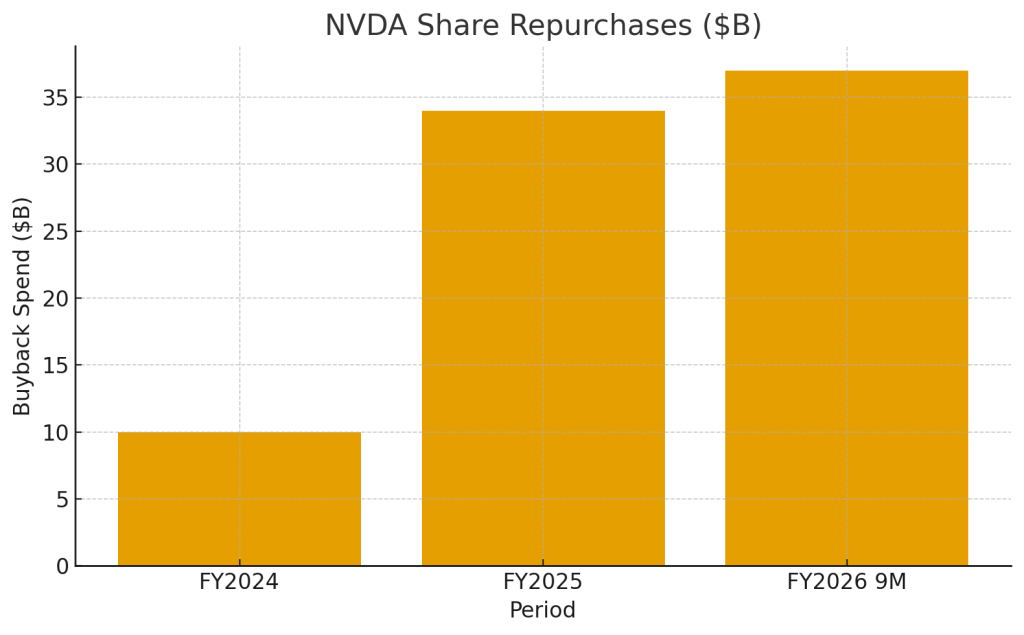
The shape of the curve:
Pre-AI Boom (Through FY2022)
- Only single-digit billions of lifetime buybacks.
- Program existed but was not central.
AI Super-Cycle Phase (FY2024–FY2026 YTD)
- FY2024: ~$9.7B repurchased (≈21M shares)
- FY2025: ~$34B repurchased (≈310M shares)
- Funded from ~$64B operating cash flow
- FY2026 YTD (first 9 months): ~$36–37B repurchased (≈262M shares)
- About $62B authorization still unused at Q3 FY26
- Total in FY25–FY26 YTD: ~570M shares retired for ~70B
In just two fiscal years, NVIDIA retired half a billion shares, dwarfing the entire pre-2023 program.
Share Count Trend
Despite enormous SBC, the diluted share count is slightly lower than in 2018 — down ~2% over seven years.
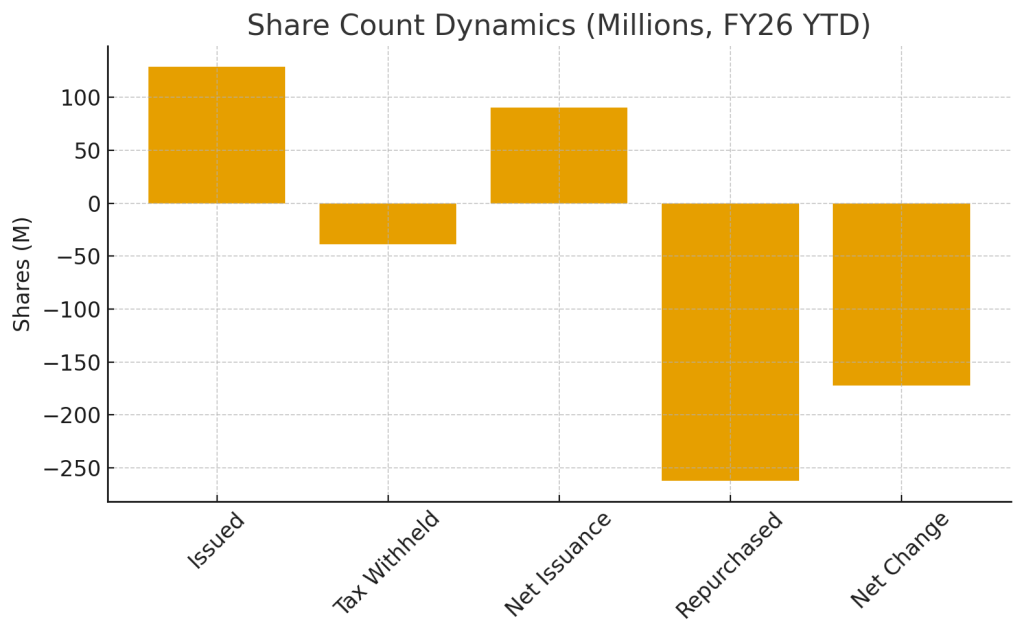
FY26 YTD breakdown:
- Shares issued: ~129M (SBC + acquisitions)
- RSU tax withholding: ~39M
- Net new shares: ~90M
- Shares repurchased: 262M
- Net reduction: ~172M shares (~0.7% share shrink in nine months)
This is real share reduction, far more than just anti-dilution maintenance.
This alone disproves Burry’s claim that share count is up “47M.”
It is actually down — not up.
EPS Accretion vs SBC: The Real Effect
FY26 year-to-date is the cleanest demonstration.
- GAAP Net Income: ~$77B
- Diluted Weighted-Average Shares: ~24.5B
- Reported EPS: ~$3.14
Now the scenarios:
| Scenario | EPS | Effect |
|---|---|---|
| Actual (full buybacks) | ~$3.14 | Baseline |
| Offset-only (repurchase only net issuance) | ~$3.12 | ~0.6% lower |
| No buybacks at all | ~$3.11 | ~1.0–1.2% lower |
Summary:
- Buybacks add ~1% EPS versus a no-buyback world.
- The “extra” beyond anti-dilution adds ~0.6%.
- The overwhelming majority of EPS growth comes from fundamentals (data-center wins, margins, scale).
But buybacks matter economically because:
- Repurchases dramatically exceed net issuance (262M vs ~90M).
- SBC is huge, but the buyback more than neutralizes it.
- Excess repurchases = real capital return.
In Buffett terms:
Buybacks above anti-dilution are owner earnings being returned.
Burry’s Critique vs Reality
Michael Burry argues:
- ~$205B cumulative net income since 2018
- ~$188B cumulative FCF
- ~$20.5B SBC
- ~$112.5B buybacks
- Share count up 47M → “buybacks create no value and only mask SBC”
Reality check:
Dollar Error
Actual buybacks since 2018 are closer to $90B — not $112.5B.
His figure appears to include RSU tax withholding.
Share Count Direction Error
Shares have shrunk, not increased.
The “+47M” claim flips the sign.
Economic Error
Average buyback price since 2018 is roughly $50 split-adjusted.
The stock now trades many multiples of that.
Those early repurchases are massively value-accretive ex-post.
Where Burry is right
- SBC is very large
- AI ecosystem has bubble behaviors
- Circular financing (NVDA investing in its own customers) is a real risk
- Depreciation timelines may prove optimistic
Where he overreaches
- Treats all buybacks as “SBC cost”
- Misreads share-count math
- Claims zero value created
The truth:
A large portion of NVIDIA’s cash generation has gone to employees,
but buybacks have still been mildly net-positive for continuing shareholders.
Do Buybacks Move the Stock?
Event Behavior
Patterns:
- Buybacks + blowout earnings = pop
- Buybacks + mixed fundamentals = no reaction
- Buybacks + China concerns = negative reaction
- Buybacks + AI overbuild fears = overshadowed
- Q3 FY26 blowout → stock reversed lower despite heavy repurchases
Conclusion: Fundamentals overpower the buyback headline.
Flow Mechanics
- Daily repurchase pace: ~1.1M shares
- Daily trading volume: 180–240M shares
- Mechanical impact: <1% of flow
Buybacks are a steady bid, not a stock mover.
Options and macro positioning swamp them.
Risks to Buybacks and Capital Allocation
The buyback only makes sense in the context of NVIDIA’s broader risk environment:
Valuation Risk
Stock trades at elevated multiples on peak-ish earnings.
If AI capex slows, the multiple compresses faster than repurchases can support.
Supply-Chain Commitments
Over $50B in non-cancellable HBM/CoWoS/TSMC commitments compete with buyback cash.
Geopolitical Risk
China export rules have already wiped out entire product lines.
New rules could repeat that.
Customer Concentration
Four hyperscaler/AI-cloud customers dominate AR and orders.
Any one of them pulling back = immediate earnings reset.
Circular Financing
NVIDIA invests in some of its own customers (OpenAI, CoreWeave).
Vendor-financed demand can unwind suddenly.
Competition
AMD, Intel, and hyperscaler ASICs eat into share from 2026 onward.
Buyback Tax Risk
1% excise tax negligible.
4% would materially reduce repurchase efficiency.
True Shareholder Value Created
From 2018 through today:
- $90–110B cumulative repurchases
- ~2% net share reduction despite huge SBC
- Early buybacks at ~$50 → massively accretive
- ~1% annual EPS accretion in FY24–FY26
- Real value came from earnings growth, not EPS engineering
Bottom line:
NVIDIA’s buybacks do create value —
but the company’s earnings explosion is what created the 10x stock move, not the buyback program.
Path Forward: What NVIDIA Should Do
Baseline – Programmatic Discipline
- Maintain steady 10b5-1 repurchases
- Primary objective: neutralize SBC
- Secondary: gentle share shrink
- Fund only after:
- Supply commitments (6–8 quarters)
- R&D and platform investments
- Liquidity buffers
Accelerate Only When
- Valuation dislocates on sentiment (not fundamentals)
- Large SBC vesting windows require offset
- Supply-chain prepayment needs get lighter
Slow or Pause When
- Export controls hit
- HBM/CoWoS commitments spike
- Large M&A or inventory write-downs occur
- Buyback tax hikes
This is what separates responsible capital allocation from top-tick destruction.
How to Frame NVDA Going Forward
Structural View (3–5 Years)
- The AI infrastructure build-out remains the backbone of the thesis
- CUDA + networking + ecosystem remains a substantial moat
- Even with competition, total demand can produce strong multi-year earnings
- Buybacks likely drive 1–2% share count shrink per year
Cyclical / Valuation View (12–24 Months)
- The risk is that the market has over-extrapolated AI demand
- Any capex pause, export shock, or margin compression triggers derating
- In that world, buybacks do not save the stock —
they merely cushion the descent
Blunt Take
NVIDIA is an AI infrastructure superpower — but the easy multiple expansion is done.
The buyback is supportive, not thesis-defining.
If you are going to own NVDA, own it for AI demand and competitive moats, not because of a $62B authorization.
Disclaimer: This analysis is for educational purposes only and does not constitute financial advice. Conduct your own due diligence and consult with a licensed financial advisor before making investment decisions.