



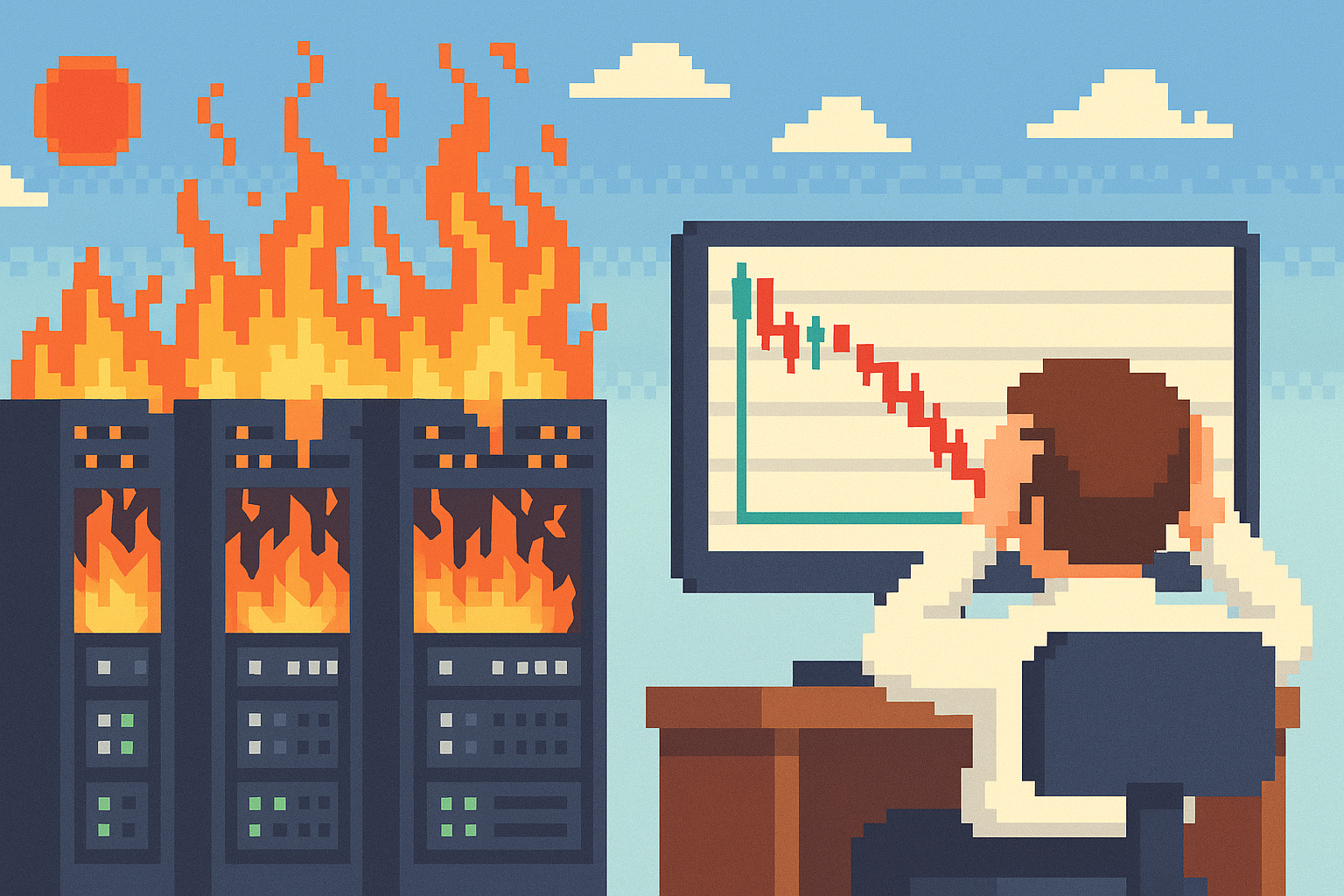

When a single overheated facility can shut down one of the world’s most important futures exchanges, “data center cooling” stops being a boring line item and becomes systemic risk.
That’s exactly what the CME outage highlighted: AI-heavy racks are now drawing so much power per square foot that cooling, not servers, is the choke point. Over the next 12–24 months, the easiest response for exchanges, hyperscalers, and colo operators is simple: spend more on cooling, and spend it faster.
This piece maps the likely corporate winners from that shift and sketches out where the upside still looks compelling vs where the market is already paying full price.
In a Nutshell
- Structural driver: AI and high-density compute are pushing rack power from the old 10–20 kW norm into the 80–300 kW range. A lot of existing halls simply weren’t built for that, which forces rapid retrofits and new builds with advanced liquid and hybrid cooling.
- Clear upside candidates:
- Carrier Global (CARR) – data center revenue is inflecting from a small base toward roughly a billion dollars, yet the stock still trades more like a traditional HVAC name than an AI-infra play.
- nVent Electric (NVT) – data center orders are growing triple-digit, and a fresh liquid-cooling portfolio is rolling out into the peak of AI deployment.
- Munters (MTRS) – landed a very large, multi-year hyperscale cooling order that materially de-risks the growth story.
- Eaton (ETN) – acquiring Boyd Thermal gives it a “power + liquid cooling” bundle that’s underappreciated by a market still thinking of Eaton as just a power company.
- Mostly priced-in leaders:
- Vertiv (VRT), Schneider Electric (SU), Trane Technologies (TT) already trade on rich multiples that assume strong AI cooling growth and margin expansion. They’re quality assets, but upside now depends on earnings beats, not discovery.
- Platform beneficiaries:
- Johnson Controls (JCI) and Equinix (EQIX) benefit as they build AI-ready, liquid-capable capacity, but cooling is one driver among many. They’re good “infrastructure baskets” rather than pure cooling trades.
Think of it as a cooling barbell: on one side, high-quality but expensive leaders; on the other, fast-growing “upgraders” where the market is still catching up to the cooling story.
Why the CME outage matters more than one bad day
The CME incident did two important things:
- Proved cooling is a single point of failure.
Markets don’t care whether a shutdown is caused by a software bug, a power issue, or a chiller fault — downtime is downtime. Exchanges, banks, and major trading venues will now treat cooling resilience the way they treat power redundancy. - Pulled forward spending.
Many operators already had multi-year plans to support AI workloads. A high-profile outage is the kind of event that turns “we’re planning to upgrade” into “we’re upgrading this budget cycle.”
Technically, the problem is simple to state and expensive to fix:
- Next-gen GPU racks are routinely running at tens to hundreds of kW per rack.
- A lot of live facilities were engineered for an order of magnitude less.
- Bridging that gap needs direct-to-chip cold plates, rear-door heat exchangers, bigger chillers, more sophisticated controls, and more service capacity to keep it all running.
That’s the backdrop for the companies below.
Tier 1 – “Re-rating” Cooling Plays (Real Upside Left)
Carrier Global (CARR) – From HVAC to AI-grade thermal
What they do
Carrier sells a full suite of high-efficiency chillers and increasingly liquid-ready cooling systems for data centers, including large centrifugal and magnetic-bearing chillers, plus controls and services that tie into AI-heavy halls.
Why it benefits
- Data center revenue is ramping hard from a relatively small base, tracking toward around $1B as AI-driven cooling demand kicks in.
- The backlog for data center projects stretches several years out, giving Carrier visibility rather than just a one-off spike.
- Management is now openly positioning data centers as a key structural growth pillar, not a side hustle.
Upside vs priced in
- The market still tends to bucket Carrier as a “high-quality HVAC name” rather than a direct AI infrastructure beneficiary.
- If investors fully re-underwrite the data center business, there’s a credible re-rating case in the ~20–40% upside range over 12–24 months, driven by both EPS growth and multiple expansion.
Verdict: A core “cooling re-rating” candidate. You’re paying an industrial multiple for a business that’s gaining AI leverage.
nVent Electric (NVT) – High-beta liquid cooling and power
What they do
nVent builds electrical and thermal solutions: enclosures, busways, power distribution, and increasingly modular liquid-cooling gear — CDUs, manifolds, and rack-level plumbing designed for high-density AI loads.
Why it benefits
- Recent quarters show data center orders up well into triple-digit percentages, materially outgrowing the rest of the portfolio.
- The company is doubling liquid-cooling capacity and has a new portfolio of cooling and power products launching into large AI deployments over the next year.
- Partnerships with major OEMs give it a seat at the table when reference designs are set.
Upside vs priced in
- The stock has already responded to the growth story, but tariff and margin worries have kept the valuation from running as far as pure AI winners.
- If nVent proves it can maintain margins while scaling liquid cooling, earnings estimates likely move up and the multiple can drift higher.
- That points to medium-term upside in the 20–35% range, with more volatility than a Carrier or Eaton.
Verdict: For investors willing to tolerate a bumpier ride, nVent is a higher-beta bet on liquid cooling adoption.
Munters (MTRS) – Hyperscale order book as a growth engine
What they do
Munters focuses on mission-critical air and liquid systems: CRAH units, CDUs, split systems and chillers tailored for efficient hybrid cooling in large data centers.
Why it benefits
- Munters recently won a very large cooling order (hundreds of millions of dollars) from a top-tier US hyperscaler. Deliveries stretch over multiple years.
- That single deal significantly de-risks the medium-term growth path and underscores that Munters is on the shortlist for big AI cooling tenders.
- Expanded testing and manufacturing capacity in North America positions the company to handle additional US-based demand — exactly where hyperscalers are now throwing capital.
Upside vs priced in
- The stock popped double-digits on the order news, which is rational.
- Even after that move, valuation doesn’t fully reflect the step-change in backlog and earnings power locked in over the 2026–28 window.
- A reasonable base case is mid-teens annualized total return from here if execution stays solid, with additional upside if more hyperscaler wins land.
Verdict: Munters is a levered play on hyperscale cooling retrofits and AI campuses. The big order made the story more visible, but hasn’t exhausted the runway.
Eaton (ETN) – From power to “grid-to-chip” cooling
What they do
Eaton is already a heavyweight in power infrastructure: switchgear, UPS, PDUs, and modular data-center power systems. It’s now moving deeper into thermal by acquiring Boyd Thermal, a major direct-to-chip liquid-cooling specialist (CDUs, cold plates, manifolds, system integration).
Why it benefits
- The combination of Eaton + Boyd creates a single vendor that can deliver power and liquid cooling together, from the utility interconnect down to the cold plate.
- Data centers and distributed IT are being pushed to become Eaton’s largest business segment over the next couple of years, and Boyd’s revenue is heavily skewed to data centers already.
- For operators, dealing with one integrator that owns both power and cooling is attractive when you need to move quickly after a scare like CME.
Upside vs priced in
- The market’s initial reaction to the deal was cautious, focused on price and integration risk rather than strategic fit.
- Over a 2–3 year horizon, if Boyd hits its growth targets and synergies are credible, Eaton can justify a higher structural multiple than a “plain” power equipment peer.
- That implies moderate upside from current levels (call it high-teens to mid-20s percent) with the usual M&A execution caveats.
Verdict: Not a pure cooling play, but a core “infrastructure stack” holding for the cooling theme.
Tier 2 – Market Leaders, But Largely Priced In
Vertiv (VRT) – Operational king, valuation prince
Why it matters
Vertiv is arguably the benchmark for data-center thermal today: CDUs, cold plates, rear-door heat exchangers, racks, controls, and a large global service organization. It has been directly in the slipstream of AI capex, with very strong order growth and a fat backlog.
The catch
- After a huge rerating, Vertiv now trades on premium earnings multiples that already assume high-teens or better organic growth and sustained margin expansion.
- Recent acquisitions in cooling services and fluid management make strategic sense, but they also raise the execution bar.
Upside vs priced in
- From here, the risk/reward looks balanced:
- Upside is driven mainly by continued earnings beats, not multiple expansion.
- Any slowdown in AI orders, project delays, or margin wobble would be felt quickly in the share price.
Verdict: Still a high-quality core name for long-term AI infrastructure, but not the obvious place to express incremental post-CME cooling upside.
Schneider Electric (SU) – Premium compounder
Schneider bundles power, cooling and software for data centers and has signed some very large recent US data-center deals that include both power modules and thermal systems. It’s tightly linked into AI reference designs and hyperscaler projects.
But:
- A sizable chunk of Schneider’s revenue already comes from data centers, and the stock trades on a “quality compounder” premium.
- The cooling story is important but well-understood, and investors are already paying up for it.
Verdict: Excellent franchise, strong execution, but more of a steady compounder than a mispriced response to the CME wake-up call.
Trane Technologies (TT) – Strong pipeline, rich valuation
Trane has a large commercial HVAC backlog with data centers called out as a high-growth vertical and strong Americas bookings tied to AI and cloud projects.
However:
- It also sits near the top of its historical valuation range, reflecting both that backlog and a reputation for execution.
- As with Schneider, the story is one of earnings compounding rather than hidden AI cooling optionality.
Verdict: Solid exposure to data-center cooling, but more “own it if you already like it” than “fresh idea after CME”.
Tier 3 – Platform & Operator Beneficiaries
Johnson Controls (JCI)
JCI’s footprint spans building systems, chillers, controls, fire, and security. Through its Silent-Aire business, it offers scalable data-center cooling modules and CDUs, and management has been leaning into data centers as a growth driver in recent guidance.
- Cooling is a meaningful piece of the puzzle, but one of several.
- Recent outlooks already embed higher data-center contributions, with the stock responding accordingly.
Verdict: Beneficiary, but not a pure cooling thesis. Works as part of a broader infrastructure basket.
Equinix (EQIX)
Equinix is on the other side of the table: instead of selling cooling equipment, it sells AI-ready colo space.
- It is actively building halls that can support liquid-ready, high-density racks, with pilots for higher kW per rack and very tight PUE targets.
- Cooling upside shows up indirectly as higher revenue per MW and premium pricing for AI-capable space.
Verdict: A way to play the “everyone needs cooler, denser halls” theme without picking hardware winners, but not a direct cooling revenue story.
Key Risks to the Cooling Trade
Even the best theses can overheat. Key risks:
- Power and transformer gating
Cooling equipment can be ready before the grid is. Long lead times for large transformers and utility interconnections can delay energization of new capacity, pushing revenue recognition to the right. - Tariff and cost pressure
Several players in this space import critical components. Increased tariffs, shipping costs, or input inflation could compress margins unless offset by pricing power or mix. - Technology path dependence
The market is converging toward direct-to-chip and rear-door heat exchangers, while exotic immersion approaches remain niche. Vendors that bet heavily on standards that don’t win could see slower adoption. - Valuation fatigue
For names like Vertiv, Schneider and Trane, expectations are already high. Any wobble in AI capex growth, or a high-profile outage driven by something other than cooling (for example, software or power), could trigger multiple compression.
Playbook: How to Trade the Post-CME Cooling Theme
This is not investment advice, but a structured way to think about positioning:
1. Core Re-rating Basket (Cooling Specialists with Room to Run)
- CARR, NVT, MTRS, ETN
- Thesis: you’re buying under-recognized or under-bundled cooling exposure just as data-center budgets are pivoting to liquid and hybrid systems.
- Time horizon: 12–36 months, with the aim of catching both earnings growth and multiple re-rating.
2. Incumbent Leaders (Priced for Success)
- VRT, SU, TT
- Thesis: great companies, but expectations are high.
- Strategy: more suited to “buy on pullbacks, trim into euphoria” than fresh capital deployment purely because of the CME outage.
3. Platform Hedges
- JCI, EQIX
- Thesis: diversified exposure to the same trend.
- Strategy: use alongside the OEMs to smooth single-name risk, especially if you expect volatility around AI headlines.
Bottom line
The CME outage turned a quietly growing engineering concern (high-density thermal management) into a visible market risk. The likely response from operators is to:
- Accelerate liquid and hybrid cooling deployments,
- Bundle power and cooling under fewer, more capable vendors, and
- Pay up for service and integration that keeps trading venues and AI clusters online.
In that world, the market is likely to reward whoever keeps the racks cold. The trick for investors is not just to own the obvious leaders, but to lean into those names where the cooling story is real and the pricing still leaves room for the next leg higher.
Disclaimer: This analysis is for educational purposes only and does not constitute financial advice. Conduct your own due diligence and consult with a licensed financial advisor before making investment decisions.